
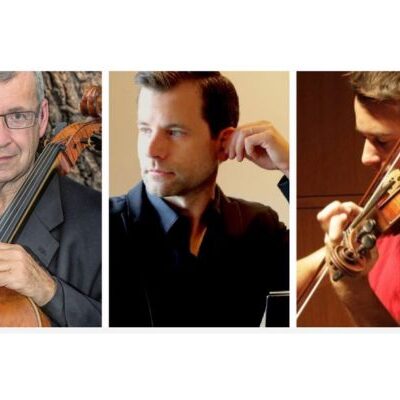
The Sords-Walz-Durkovic Trio (Andre Sords, violin; John Walz, cello; and Timothy Durkovic, piano) opened the 2026 concert season at Boston Court in Pasadena with a program devoted to the chamber music of Johannes Brahms.
The concert opened with a performance of Brahms’ Sonatensatz (from the F.A.E. Sonata) for violin and piano. The F.A.E. sonata is a four-movement work composed by three composers: Robert Schumann, his pupil Albert Dietrich and Brahms, as a tribute to the great 19th-century violinist Joseph Joachim. F.A.E. comes from the German Frie aber einsam (“free but lonely”), a motto which Joachim had adopted. Brahms was assigned to compose the scherzo, which is called the Sonatensatz in his oeuvre.
Brahms’ scherzo (in C minor) is characteristically stormy and allowed the performers — Sords and Durkovic — to open the concert with a jolt. Both performers dug into the music to convey the edginess of the movement and were in perfect sync.
The first half concluded with Brahms’ Sonata in E minor, Op. 38 for cello and piano. As Walz announced before they started playing, this sonata was the first of seven sonatas Brahms wrote for individual instruments and piano. Brahms titled the work Sonate für Klavier und Violoncello, however, indicating that both instruments are equal and that the piano does not simply play an accompanying role, a statement that could be said not only about his other sonatas but about his concertos as well.
The theme of the first movement and the fugue in the fourth movement are based on Contrapunctus 4 and 13 of The Art of the Fugue by Bach, and the entire sonata is just as turbulent as the Sonatensatz and the C-minor Trio that followed after intermission.
Walz, no stranger to Boston Court (he was born and raised in Pasadena) or to the chamber music scene in LA, showed his trademark facility with the cello as he navigated the musical and technical demands of the sonata. Durkovic demonstrated his equal skills on the piano (Brahms’ piano writing is not always so easy), despite the fact that Brahms suggested that neither part was particularly difficult to play.
After a brief intermission, all three musicians performed Brahms’ Piano Trio No. 3 in C minor, Op. 101 continuing the theme of pieces in minor keys. The musicians gave the all-too-small audience an engaging and balanced performance that brought to life all the emotional energy Brahms put into this trio.
Rather than assume the audience would call for an encore, the trio added the Hungarian Dance No. 6 in D-flat major. This rousing dance transcribed for piano trio ended the evening on a more uplifting note (literally!) and in a major key, and the audience showed their appreciation for the Sords-Walz-Durkovic Trio and, at least for this listener, for the intimate and wonderfully acoustic space at Boston Court.
—Henry Schlinger, Culture Spot LA
For information about upcoming performances at Boston Court, visit https://bostoncourtpasadena.org.