
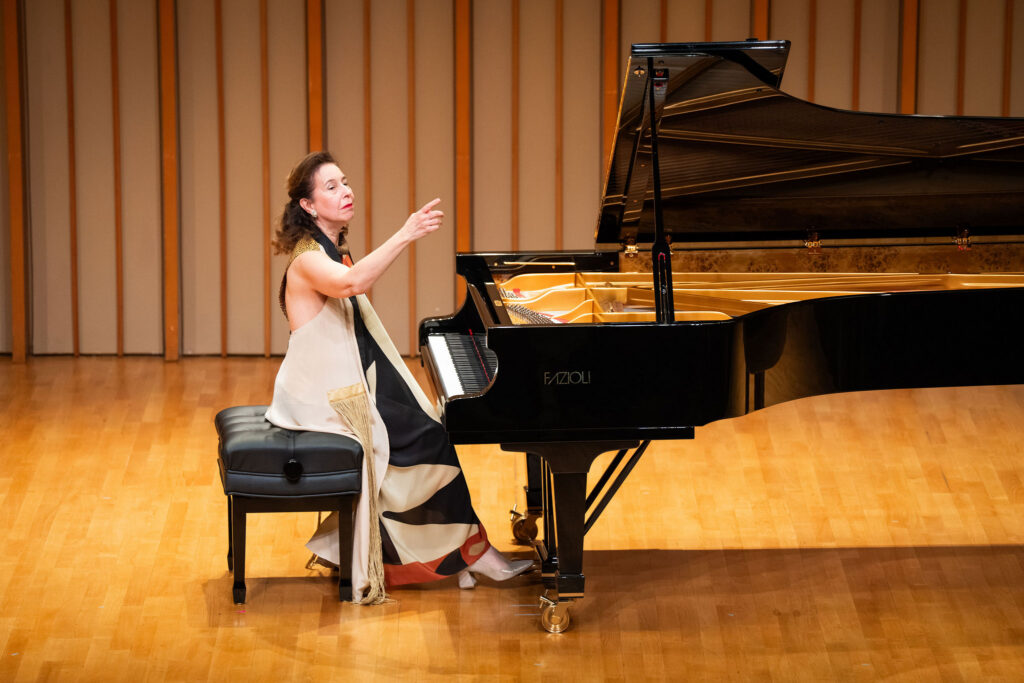
On Oct. 13, the famed pianist Angela Hewitt performed a recital of works by Mozart at Zipper Hall as part of the LACO 2026-2027 season.
On the program were the Fantasy No. 3 in D minor, K. 397, the Sonata for Violin and Piano in G Major, K. 301 with LACO Concertmaster Margaret Batjer, the Piano Sonata No. 17 in B-flat Major, K. 570, the Fantasy No. 4 in C minor, K. 475, and the Piano Sonata No. 14 in C minor, K. 457.
Before she began playing, Hewitt walked on stage with a microphone and explained to the audience why she planned this particular program. She mentioned that most of us might know her for her decades-long foray into the keyboard music of Bach. She also mentioned that she had recorded all 32 piano sonatas by Beethoven. But recently she has been immersed in the music of Mozart. She is in the process of performing all 27 piano concertos with different orchestras and conductors.
Hewitt then talked about the pieces on the recital’s program, reminding the audience that Mozart was primarily an opera composer and that his instrumental music always sings.
With the exception of the Sonata for Violin and Piano, the program was divided into essentially two parts, each including a fantasy and a piano sonata. The first part included the Fantasy in D minor and the Piano Sonata in B-flat Major; and the second part included the C minor Fantasy and Piano Sonata.
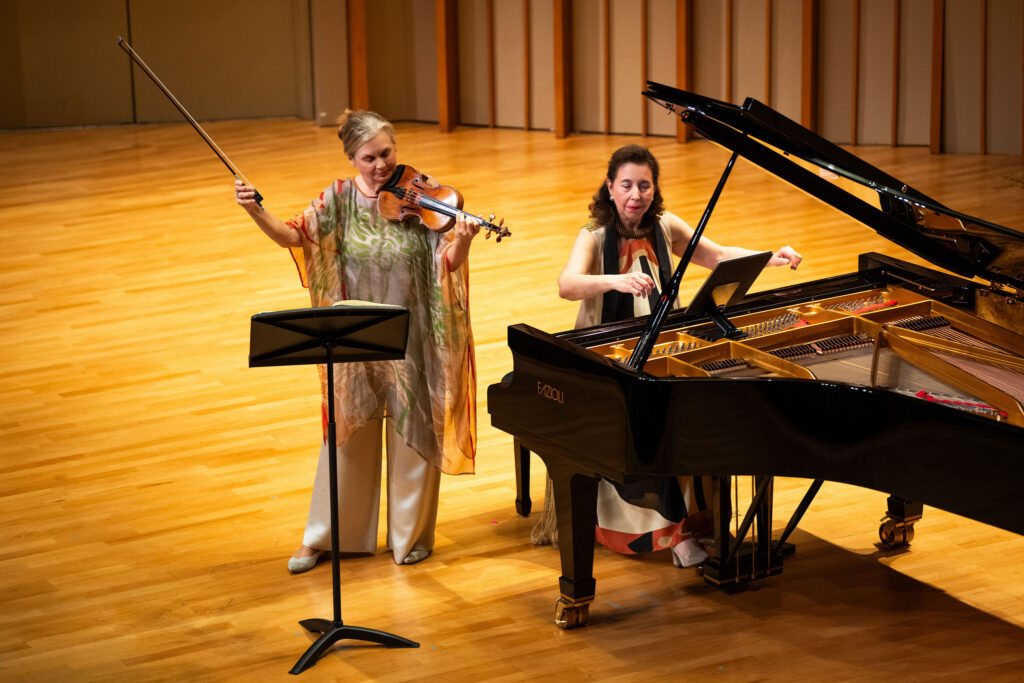
Hewitt was joined by Batjer for the two-movement Sonata for Violin and Piano in G Major, K. 301. Hewitt said that this particular piece was suggested by Batjer. Even though Mozart was also a violinist, his violin and piano sonatas, unlike those of Beethoven and later composers like Brahms, were actually piano sonatas with violin accompaniment. The G Major Sonata is particularly light and airy, and Hewitt and Batjer performed it elegantly.
Angela Hewitt performed an hour and 30 minutes of Mozart at the highest level, maintaining clarity and sensible voicing throughout. She brought an interesting and assuredly new approach to interpreting the Mozart pieces, something that probably stems in part from her expertise in Bach and Beethoven. However, even in her own unique interpretations, she still kept the pieces sounding conspicuously Mozartian. She was careful to balance pedaling and clarity (a trait found in Bach), with emotionality and expression (something found in Beethoven). She maintained careful consonance with Margaret Batjer during the Violin Sonata in G Major, which was a delightful introduction to that piece. She was also incredibly respectful of the source material. Her interpretation of the Piano Sonata in C minor was new and refreshing, while simultaneously more faithful to Mozart’s sparse dynamic and articulation markings.
Not only did Hewitt perform these pieces exquisitely and sensitively, but she imparted to the audience the joy that she apparently felt playing them. Her hands caressed the keys, and at times lifted off them as if she were conducting the music. She must’ve played these pieces dozens if not hundreds of times, and yet it was as if she were playing them for the first time and discovering their beauty.
—Henry Schlinger and Haydn Schlinger, Culture Spot LA
For more information about LACO’s 2026-2027 season, visit www.laco.org.
Photos of Angela Hewitt and Angela Hewitt with Margaret Batjer by Elizabeth Asher Photography